

Overcoming AI-Powered Price Optimization Challenges

Updated: Apr 29
A practical guide to turning complexity into competitive advantage
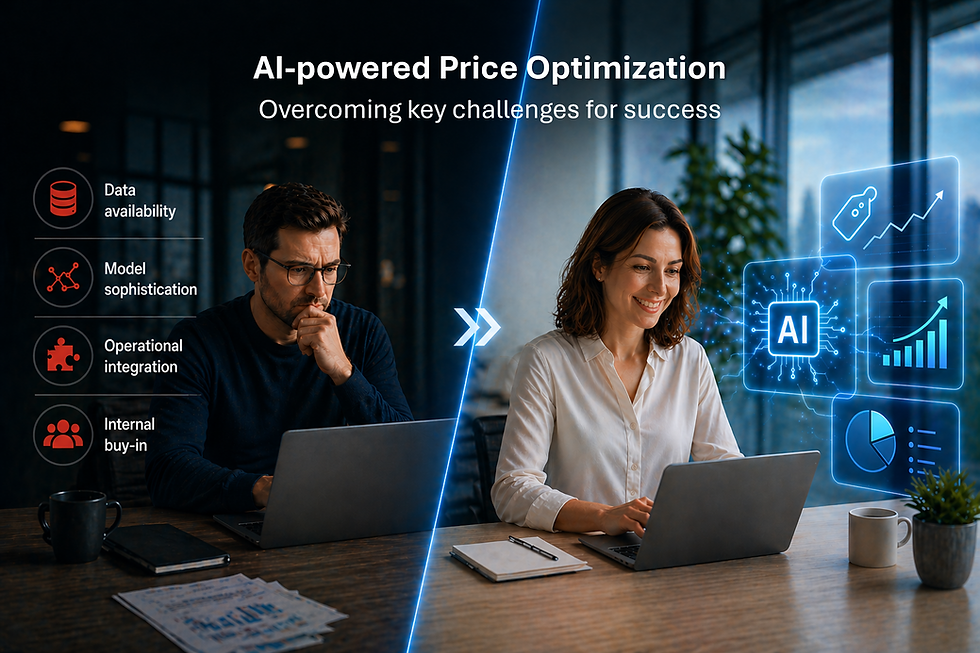
Price optimization has always been challenging — but AI has raised both the ceiling and the stakes. Done right, it becomes a powerful growth engine. Done poorly, it amplifies bad decisions at scale.
Today, most companies are still stuck in the “NOW” state — fragmented data, unclear signals, limited internal alignment, and reactive pricing decisions. The opportunity is to move toward the “AFTER” state — structured data, clear insights, aligned teams, and confident, proactive pricing.
So how do you actually make AI-powered pricing work in practice — while balancing business objectives, data reality, model sophistication, and organizational alignment?
Here’s how! 👇
Setting the Right Objectives: What Are You Optimizing For?
This is where many AI pricing initiatives quietly fail.
If you don’t define the objective clearly, the model will optimize the wrong thing perfectly.
➡️ Possible optimization objectives:
Maximize profit
Improve margins
Drive revenue growth
Increase volume/market share
Reduce churn
➡️ Reality:
Objectives are often conflicting
You need to combine them with clear constraints to strike the right balance
For example, you can:
Maximize profit while limiting volume and revenue losses below a threshold
Maximize revenue or volume with minimum profit margin (profitable growth)
Practical tip: Translate business strategy into quantitative objectives and guardrails. AI doesn’t decide strategy — you do.
Data Availability & Quality: Progress Over Perfection

Everyone says “data is key.” True, but also misleading.
If you wait for perfect data, you’ll never start. If you use bad or irrelevant data, you’ll make things worse.
The sweet spot: usable, relevant, continuously improving data.
What matters most:
Relevance: What pricing-related data do you have? For instance, sales transactions, discounts, win/loss, or competitor signals.
Availability: Do you have enough historical data to detect patterns? You can’t fit a sophisticated model on a handful of data points — but you also don’t need “big data” to get meaningful pricing guidance.
Reliability: Is it directionally correct, even if not perfect? Even invoice data contains noise — for instance, changing units, product variants, bundles, rebates, or exchange rates. You don't need perfection, but you do need harmonization and directional accuracy.
Common mistake: Trying to gather and cleanse all data and integrate every system before doing anything useful.
👉 The goal isn’t perfect data — it’s decision-grade data.
Better approach:
Start with core datasets: sales transactions, price history, and, if available, costs.
Layer in complexity later: competitors, marketing actions, supply disruptions, or other external factors.
Practical tip: In B2C, usually it's easy to have thousands of transactions per SKU - in B2B, this is harder, but often a few hundred transactions could be enough to train the predictive model.
Market Research vs Real Data: Use Both As Needed
Market research tells you what customers say. Transactional data tells you what they do.
Depending on your context and data availability, you may need one or both.
Use market research for:
New products
New markets
For products with limited or biased past traction
Anything outside established historical patterns
Use real data for:
Existing products
Mature markets
Sufficient past traction
Anything within established historical patterns
Practical tip: Use historical data by default — and fill gaps with market research when needed.
Model Sophistication: Match the Complexity to the Business
Not all pricing problems require the same level of intelligence. Over-engineering is just as dangerous as under-engineering, especially when comparing B2C and B2B environments:
➡️ B2C:
High volume, lower complexity, and value per transaction
Models focus on:
Demand elasticity
Segmentation
Promotions
Real-time adjustments
Practical tip: Speed and scale matter more than deep explainability
➡️ B2B:
Lower volume, higher complexity, and value per transaction
Each deal can be unique
Models focus on:
Demand vs supply dynamics (process and capacity limitations)
Customer context (customer and deal characteristics)
Economic intelligence (willingness-to-pay, econometric modeling)
Practical tip: Explainability matters more — sales and the C-suite need it
Required Accuracy: Exact vs Directional
Another trap: expecting AI to deliver perfect insights.
That’s unrealistic — and unnecessary.
Two modes of value:
1️⃣ Exact pricing (high precision)
It may be needed in:
Highly price-sensitive environments
High volume, high frequency sales
Public, or difficult to change, or regulated pricing
Often met in B2C
2️⃣ Directional guidance (high impact, lower precision)
It may be needed in:
Less price-sensitive offerings
Low volume, high value negotiated deals
Confidential, flexible per-deal pricing, without regulatory restrictions
Often met in B2B
Examples:
Psychological pricing: In B2C, crossing a psychological threshold from $99.99 to $100.00 can often cause a significant decline in sales, so precision matters.
Price negotiations: In B2B, an official list price of $1,000 can end up at $800 or $700 through negotiation, so guidance is mostly directional rather than precise.
Practical tip: In B2C, we usually need more precision and have the data to support it, whereas in B2B, although we have less data, this is often enough to provide the directional guidance needed.
Measuring Success: Pick the Right KPIs
If you can’t measure it, you can’t scale it.
Core KPIs:
Profit increase
Margin improvement
Revenue growth
Conversion/win rate
Churn reduction
Advanced metrics:
Price realization/erosion
Discount reduction
Sales behavior changes
Practical tip: Always measure against a baseline (e.g., before vs after, against the median or average). For a more detailed list check out this guide. 💡
Output & Delivery: Insights Are Useless Without Adoption

Even the best model fails if no one uses it.
The question isn’t just what the model predicts — but how it reaches users.
Common delivery formats:
1️⃣ Reports / Excel outputs
Static dashboards and reports with key findings and suggestions - usually in PowerPoint, Word, or Adobe Acrobat format
Detailed action lists with optimum price suggestions and uplift estimates per SKU, segment, geography, customer, or other dimension.
Practical tip: Use when you have a few price adjustments per year in an "offline mode."
2️⃣ Dedicated software platforms
Interactive dashboards
Scenario simulation
Role-based views
Practical tip: Use when you want to explore different scenarios regularly and/or have frequent updates.
3️⃣ System integrations
Connection with the ERP, CRM, or other internal system
Continuous updates between systems
Embedded pricing guidance into corporate workflows
Practical tip: Use when you have real-time or regular updates, and you want to get pricing guidance through your internal IT systems for convenience, compliance, and control.
Different users need different experiences and information access:
Pricing teams: Deep analytics, scenario tools, action lists
Sales teams: Simple, actionable guidance (e.g., “target price”, “floor price”)
Executives (CXO): High-level KPIs, impact tracking
Practical tip: One-size-fits-all UI kills adoption. Adjust your approach based on use case and your intended target audience.
Internal Buy-In: Where Most Pricing Initiatives Fail
Even the best pricing models fail without adoption.
Common concerns:
Sales: “We’ll lose deals”
Marketing: "We'll lose growth"
Finance: “We’ll lose margin”
Leadership: “Show me results fast”
How to build trust:
Out-of-sample validation (prove it works on unseen data)
Sanity checks (does it make business sense?)
Pilot projects (start with small, quick wins, then scale)
A/B testing & price experiments (validate in real market conditions)
Clear communication & training (ensure understanding and adoption)
C-suite sponsorship (secure alignment and accountability)
Practical tip: You’re not just deploying a model — you’re driving a mindset shift and leading organizational change.
Final Thought
AI-powered pricing is not just a modeling problem — it’s a business system.
It requires the right:
Data (not perfect, but reliable)
Predictive model (not overbuilt, but fit-for-purpose)
Objectives (realistic and grounded to corporate goals)
Organizational alignment (to ensure execution and minimum resistance)
Get these right, and AI-powered pricing becomes a true strategic advantage. Get them wrong, and you'll simply miss a major opportunity to differentiate.
Interested in learning more about AI-Powered Price Optimization and Strategic Forecasting?


Comments