The Pricing Activation Framework

Updated: May 11
From Diagnostics to AI-Powered Guidance and True Business Impact

Pricing has always been one of the most powerful levers for business performance. A small pricing improvement can have a disproportionate effect on profit, often more than equivalent improvements in volume or cost.
Yet in many organizations, pricing remains underused, underanalyzed, or treated as a periodic commercial exercise rather than a strategic capability.
The problem is rarely a lack of data. Most companies already have dashboards, sales reports, margin reports, and customer information. The real challenge is turning all of this into clear pricing decisions that the business can trust, adopt, and execute.
This is where modern pricing is evolving: from diagnostics to a deeper understanding of price sensitivity, to AI-powered pricing guidance, and to measurable business impact.
Start with diagnostics: understand where you are
Before deciding where prices should go, companies need to understand what is happening today. A strong pricing diagnostic provides visibility into the business's current pricing reality.
It helps answer essential questions such as:
Are we winning or losing?
In which products, markets, segments, or customer groups?
What is driving revenue and profit changes?
Are price changes actually improving margin, or are they being offset by volume losses, mix shifts, or cost increases?
Typical diagnostic approaches include:
Sales and price analytics: Tracking volume, revenue, average price, and discounting over time.
PVM analysis: Breaking down profit or revenue changes into the impact of price, volume, mix, and cost effects.
Price dispersion: Understanding how prices vary across geographies, segments, customers, and channels. Wide price dispersion may indicate opportunity, but it may also reflect differences in value, competition, customer size, or contract terms.
Profitability analysis: Monitoring profit, gross profit, and margin trends across products, customers, channels, and markets.
Market and competitor intelligence: Capturing competitor pricing, market movements, customer expectations, demand trends, and cost changes.
Benchmarking: Comparing pricing levels against internal expectations, such as cost plus minimum margin, and external factors, such as competitors’ pricing, company positioning, and market best practices.
Current elasticity estimates: Assessing how volume sold has historically reacted to recent price changes.
These diagnostics provide direction and context. They help the organization understand where it is exposed, where it has pricing power, and where pricing decisions may be creating unintended consequences.
Modern BI systems, dashboards, and automated reporting can all support this phase. Generative AI can also be useful for searching, summarizing, and structuring large volumes of internal and external pricing-related data.
But diagnostics are only the beginning. They explain what happened, but don't fully tell you what will happen next.
Go beyond elasticity
Elasticity is often treated as the core measure of price sensitivity. However, although useful, it's usually not enough.
In practice, elasticity is not a fixed number. It changes depending on:
Macro conditions: Inflation, exchange rates, and overall spending power reshape how customers react to prices.
Market dynamics: Competitor pricing, new entrants, and category shifts can alter perceived value and willingness to pay.
Value proposition evolution: Your product today may not be the same as it was six months ago. The same for competitors. Features, brand perception, and differentiation evolve.
Customer mix changes: Different segments have different sensitivities. As your mix shifts, so does your observed elasticity.
Price level itself: As prices increase, products often become more price-sensitive. As prices decrease, the incremental volume response may weaken.
This is why companies need to move beyond simply asking, “What is the elasticity?” to asking:
How will volume, revenue, margin, and profit respond to different price actions under different conditions?
That question requires a more sophisticated approach.
Discover true price sensitivity
To understand true price sensitivity, companies usually need a combination of historical data, market research, and predictive modeling.
Gathering historical data related to your pricing, sales, and market dynamics is often the first logical step. This could be:
Sales transactions (ERP system)
Won/lost information (CRM system)
Customer support data (ERP, CRM, other internal systems)
Product usage information (tracking systems, customer feedback)
Competitor pricing (web scraping, field intelligence)
Market trends (macro data, market reports)
Seasonal demand patterns (ERP system, market reports)
In practice, it often makes sense to start with the sales and pricing data already available in ERP systems, then enrich it with additional sources where they add explanatory power.
Market research is particularly valuable when historical data is limited, unreliable, or not representative of the future. This often applies to new products, new markets, major repositioning, or categories where the business is considering a more fundamental change in pricing strategy.
Common research approaches include:
Van Westendorp price sensitivity analysis: Useful for identifying perceived acceptable price ranges.
Gabor-Granger analysis: Helpful for estimating purchase likelihood at different price points.
Conjoint analysis: Powerful for understanding trade-offs between price, features, brand, service, and other value drivers.
Value mapping and value matrices: Useful for comparing perceived value against price and competitors.
Neuroscience and behavioral research: Helpful when emotional, subconscious, or behavioral drivers strongly influence purchase decisions.
Market research can reveal what customers value and how they may respond to different price points in areas with greater uncertainty and/or limited data availability.
However, market research or gathering historical information is not enough. Available data needs to be analyzed to identify price-response patterns and their key drivers.
This is where Predictive AI becomes powerful.
Predictive AI can help companies model how different products, customers, or markets respond to price changes while considering multiple influencing factors at the same time.
Instead of relying solely on averages, it can detect patterns across geography, segments, customer types, product characteristics, deal structures, competitive context, and market conditions.
More specifically, Predictive AI can support pricing by:
Segmenting customers by price sensitivity: Not all customers respond to price in the same way. AI can help identify where the business has pricing power and where price changes may create risk.
Forecasting volume, revenue, margin, and profit across price points: This allows teams to compare scenarios before taking action.
Incorporating multiple business drivers: Predictive AI can consider geography, customer type, payment terms, product attributes, deal size, contract duration, competitor activity, seasonality, promotional intensity, macroeconomic indicators, and market trends.
Combining historical data and market research: Where transaction data is strong, AI can learn from actual behavior. Where data is limited, research outputs can help enrich the modeling.
Generating multiple scenarios: Leaders can evaluate what may happen under different assumptions, such as changing market conditions, competitors' actions, capacity constraints, or improved sales execution.
The goal of Predictive AI should not be create a black box, but to provide better guidance for human decision-making.
Decide what to do: pricing must follow the objective
Once the business has a clearer view of true price sensitivity, the next question is strategic: what are we trying to achieve?
Pricing decisions should not be made in isolation. A price increase that maximizes short-term profit may reduce volume, damage customer relationships, or weaken market share. A discount strategy that increases revenue may dilute margins and train customers to wait for lower prices.
Common pricing objectives include:
Maximizing profit
Improving margins
Driving revenue growth
Increasing volume or market share
Reducing churn
In reality, objectives often conflict. That is why the pricing strategy should combine clear goals with explicit constraints. For example, a company may choose to maximize profit while keeping volume loss below a defined threshold, or to maximize revenue while maintaining a minimum gross margin.
This is where AI-powered scenario planning becomes more valuable, by allowing decision-makers to compare trade-offs, not just outputs.
The conversation changes from “What price should we set?” to “Which pricing strategy best balances our objectives, risks, and constraints?”
Move from insight to pricing guidance
Once objectives and constraints are clear, Predictive AI can help translate analysis into actionable pricing guidance.
This may include:
Strategic price optimization: Identifying optimal price points for profit, revenue, margin, or other business KPIs.
Uplift forecasting: Estimating the expected impact of price changes on volume, revenue, profit, and margin.
Growth driver analysis: Identifying which factors beyond price are driving performance, such as market conditions, geography, customer segment or type, channel, product attributes, deal characteristics, competitor movements, promotional intensity, capacity constraints, or sales execution.
Deal pricing guidance: Supporting sales teams with recommended price corridors, target prices, approval guidance, and customer-specific negotiation support.
Scenario planning: Generating different business outcomes under alternative assumptions, such as inflation, market slowdown, competitor reaction, or supply constraints.
Dynamic pricing: Adjusting prices continuously based on demand, availability, competition, and market signals.
Surge pricing: Adapting prices based on real-time supply-demand imbalances, where appropriate and acceptable for the market.
The right use case depends on the business model. A B2B manufacturer may benefit most from strategic price optimization and deal guidance. A SaaS company may focus on packaging, willingness to pay, churn, and customer lifetime value. A retailer may prioritize dynamic pricing and promotion optimization.
The principle is the same: pricing guidance must be specific enough to support decisions, acceptable by the market, and practical enough to be used by the organization.
Execution is where pricing impact is won or lost
Even the best pricing guidance and analytics will fail if the business does not act on them.
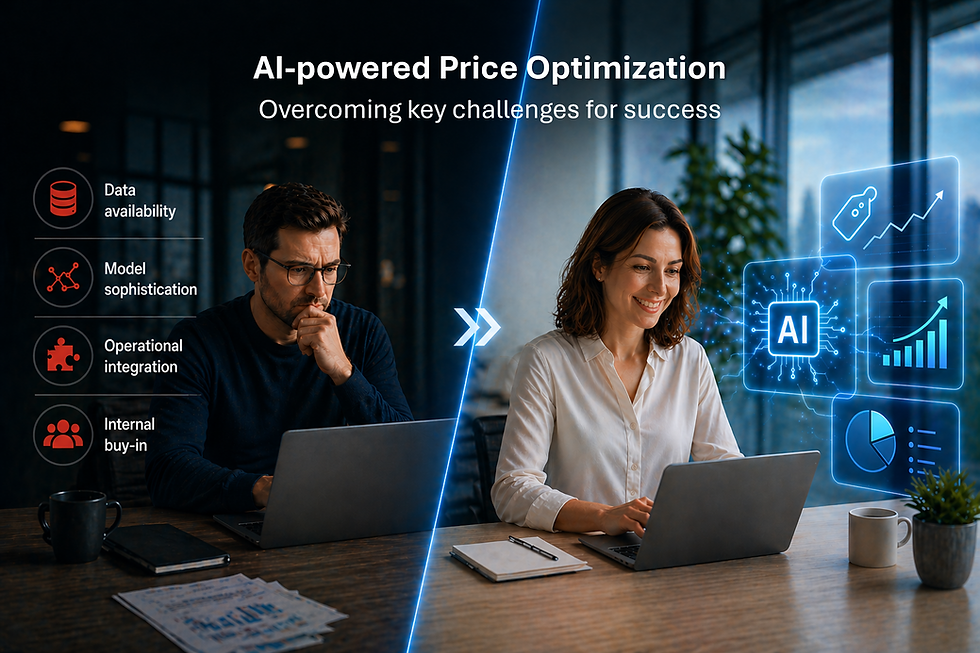
This is one of the most underestimated parts of pricing transformation. Companies often invest in advanced models, dashboards, or pricing software, but the recommendations go unused because the organization is not ready or sufficiently aligned to execute.
Several barriers commonly appear:
Limited internal buy-in: If sales, finance, marketing, product, and leadership do not endorse the recommendations, pricing stays on paper. Sales teams in particular need to understand the logic, the customer impact, the negotiation room, and how the new guidance aligns with their incentives.
Wrong delivery format: Different stakeholders need different outputs. Executives may need a clear story, financial impact, risk assessment, and strategic recommendation. Sales teams need practical account-level or deal-level guidance. Pricing teams need more detailed analysis, assumptions, and governance rules.
Enterprise disruption: If a pricing initiative requires major software deployment, system integration, process redesign, or significant workflow changes, adoption may slow. In most organizations, a pragmatic approach works better, with periodic pricing recommendations, focused action lists and insights, and phased rollouts.
Lack of governance: Pricing decisions need ownership, approval logic, monitoring, and feedback loops. Without governance, the business may either ignore recommendations or apply them inconsistently.
No measurement loop: Pricing impact should be tracked after implementation. Did the expected uplift materialize? Did sales override the guidance? Did competitors react? This feedback improves future recommendations.
The path to impact is not only analytical. It is organizational.
Successful pricing initiatives combine strong data insights and predictive analytics with clear communication, internal alignment, simple decision processes, and practical execution support.
The role of AI: not replacing judgment, but upgrading it
AI is changing pricing, but not by removing human judgment. Pricing is too strategic, complex, and context-dependent to be fully automated in most businesses.
The real value of AI lies in enhancing decision-making through effective Human-AI collaboration.
It helps companies move from backward-looking reporting to forward-looking guidance. From average elasticity to price sensitivity based on several factors. From generic price increases to targeted actions. From intuition-led decisions to evidence-based strategy. From static dashboards to recommendations that can be tested, refined, and embedded into commercial workflows.
But AI must be used responsibly. Pricing decisions affect customers, sales teams, brand perception, competitive position, and sometimes public trust. The best pricing systems are not just technically accurate. They are explainable, governed, and aligned with business strategy.
AI should answer questions such as:
Where do we have pricing power?
Where are we at risk of volume loss or churn?
Which customers or segments need a different approach?
What is the expected financial impact of each pricing action?
Which internal or external factors should we consider?
What assumptions are driving the recommendation?
How confident are we in the recommendation, and where do we need human review?
That is how AI becomes a pricing capability, not just an analytical tool.
Pricing impact comes from connecting insight with guidance and action
Pricing excellence is not achieved by diagnostics alone. Diagnostics show the current reality. Elasticity provides an initial signal. Research adds customer understanding. Predictive AI reveals deeper response patterns. Optimization and scenario planning help define the best course of action.
But business impact only happens when the organization acts.
The future of pricing is in the ability to connect analytics and sophisticated tools with strategy, strategy with execution, and execution with measurable outcomes.
Companies that build this capability will price with more confidence. They will understand where they can push, where they should protect, and where they need to adapt. They will move faster, communicate better, and make pricing decisions that are both commercially ambitious and operationally realistic.
In an environment of volatile market conditions, changing customer expectations, aggressive competition, and increasing pressure on margins, pricing can no longer be treated as a periodic adjustment.
Pricing must become a continuous, AI-enabled business discipline. Companies that master it will not simply set better prices, but make better decisions and achieve stronger outcomes.
AI-driven pricing insights to unlock hidden revenue & margin
Using your data. Minimal involvement. No implementation needed.